
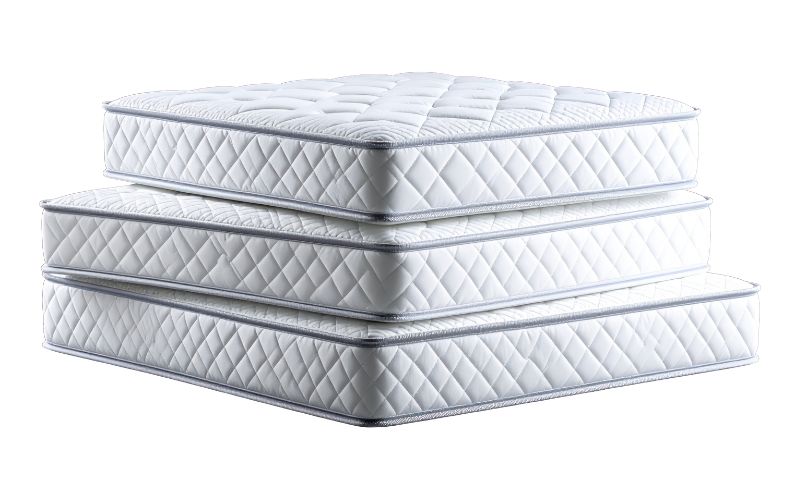
The right mattress type depends on how you sleep. Side sleepers usually do best on memory foam or a softer hybrid. Back and stomach sleepers tend to prefer firmer hybrids or innerspring. If you’re shopping for a hybrid mattress in Great Falls or any of the other two main types, the best move is to match the bed to your sleep position, body weight, and what bothers you most at night.
There’s no universally “best” mattress. There’s only the best mattress for you. Let’s break down how each type works, who it suits, and how to pick.
How Each Mattress Type Is Built
Before comparing them, it helps to know what’s actually inside each one.
Innerspring mattresses use a steel coil core with a thin comfort layer of foam or fiber on top. They’ve been the standard for decades. Air moves freely between the coils, which keeps them cool, and the bounce is what most people grew up on.
Memory foam mattresses are built entirely from foam layers. The top layer is a viscoelastic foam that softens with body heat and conforms closely to your shape. Underneath are denser support foams that hold everything up.
Hybrid mattresses combine both. They have a pocketed coil base for support and breathability, plus several inches of foam on top for pressure relief. They’ve become the most popular mattress type in the country because they balance the strengths of foam and innerspring.
Comparing the Three at a Glance
| Feature | Innerspring | Memory Foam | Hybrid |
| Bounce/responsiveness | High | Low | Medium |
| Pressure relief | Low | High | Medium-high |
| Motion isolation | Low | High | Medium-high |
| Cooling | High | Lower (varies) | Medium-high |
| Edge support | Medium | Lower | High |
| Price | Lowest | Mid | Highest |
| Best for | Hot sleepers, budget shoppers | Side sleepers, joint pain | Most sleep types |
Match the Mattress to Your Sleep Position
Your sleep position is the single biggest factor in choosing a mattress type. According to Harvard Health, more than 60% of adults sleep on their side, with back sleeping the second-most common.
If You’re a Side Sleeper
Side sleeping puts pressure on your shoulder and hip. You need a bed that lets those points sink in just enough so your spine stays straight. Too firm, and you’ll wake up with shoulder pain. Too soft, and your hips will sag and twist your back.
Best fit: Memory foam or a softer hybrid (medium feel). The contouring layers cushion the pressure points while still keeping you supported.
If You’re a Back Sleeper
Back sleeping needs a mattress that supports the natural curve of your lower back without letting your hips drop. Too soft and your lower back caves in. Too firm and there’s a gap between the mattress and your lumbar spine.
Best fit: Medium-firm hybrid or innerspring. The hybrid gives you contour through the comfort layer with the support of coils underneath. A quality innerspring can also work well.
If You’re a Stomach Sleeper
Stomach sleeping is the toughest position to support. Your hips are the heaviest part of your body, and gravity pulls them down into the mattress. If the bed is soft, your spine ends up in a U-shape all night. Keck Medicine of USC actually recommends avoiding stomach sleeping when possible because of the strain it puts on the spine.
Best fit: Firm hybrid or firm innerspring. You want enough support to keep your hips from sinking. Pure memory foam is usually too soft for stomach sleepers.
If You Switch Positions
Many people change positions through the night without realizing it. If that’s you, look for a mattress that can handle multiple positions. A medium-firm hybrid is usually the best choice because it’s responsive enough for easy movement but still soft enough to cushion your shoulders when you roll onto your side.
Match the Mattress to Your Body Weight
Body weight affects how much you compress a mattress. The same bed can feel medium to one person and soft to another.
- Under 130 pounds: You won’t sink into the mattress as much, so a softer feel often works better. Memory foam or a plush hybrid is usually a good match.
- 130 to 230 pounds: Most “average” firmness ratings will feel about right. A medium-firm hybrid is the safest choice if you’re not sure.
- Over 230 pounds: You’ll compress the mattress more than the average sleeper, so you usually want to go one step firmer. Hybrids with strong coil systems hold up better over time than all-foam beds.
What If You Have Back Pain?
Back pain changes the equation. Most clinicians today recommend a medium-firm mattress (around a 6 on a 10-point scale) for chronic lower back pain, not the rock-hard mattresses people used to be told to buy.
A hybrid mattress is often the best fit because it offers contoured support without giving up the firmness of coils. Memory foam can work well for side sleepers with back pain because it cushions pressure points, but heavier sleepers may find pure foam too soft. For more on this specific issue, see our existing piece on how a hybrid mattress can alleviate back pain discomfort.
What About Couples?
If you share a bed, motion isolation matters. Memory foam wins here. When your partner rolls over or gets up at 5 a.m. for work, you barely feel it.
Hybrids with individually pocketed coils also do a good job of isolating motion, although not quite as well as full memory foam. Traditional innerspring mattresses are the worst for this. The interconnected coils transfer movement across the whole bed.
If you and your partner have very different sleep preferences (one wants soft, one wants firm), a split king setup with two twin XL mattresses lets each person pick what works for them.
What About Hot Sleepers?
Innerspring beds run the coolest because air moves freely between the coils. Hybrids with breathable covers and gel-infused foam come in second. Traditional memory foam tends to trap heat, although newer designs with cooling gel and open-cell foam have closed much of that gap.
If you wake up sweating, ask your salesperson which mattresses use cooling layers. The difference is real.
What You’ll Find at Payless Furniture in Great Falls
At Payless Furniture & Mattress, you’ll find all three mattress types from trusted brands. Ashley Sleep makes affordable hybrid and innerspring options like the Elite Springs line, which combines pocketed coils with response memory foam. Sierra Sleep covers the budget innerspring and foam side. Both are mattress brands owned by Ashley Furniture Industries, the largest furniture manufacturer in the world (and a separate brand line from the Ashley bedroom furniture sold at Payless).
The best way to find the right type is to lie on each one in person. Stop in at 116 Central Ave. West or call 406-453-4582 to check current stock. For more on what to test and what to ask, see our full guide on mattress shopping in Great Falls.
Quick Recap
- Side sleeper? Memory foam or softer hybrid.
- Back sleeper? Medium-firm hybrid or innerspring.
- Stomach sleeper? Firm hybrid or firm innerspring.
- Couples? Memory foam or pocketed-coil hybrid for motion isolation.
- Hot sleeper? Innerspring or hybrid with cooling features.
- Back pain? Medium-firm hybrid is usually the safest bet.
- Heavier body type? Hybrid for support and durability.
There’s a lot to consider, but most people land on one of these three types pretty quickly once they know how each feels. Take 10 to 15 minutes per bed in your usual sleep position, and trust what your body tells you.